
Financial District ranked number one on StreetEasy’s most searched neighborhoods for 2026, median condo prices are up 28 percent year over year, and there are active sponsor units available right now at prices that make Tribeca look expensive by comparison. With financial district investment opportunities flourishing, savvy buyers are looking to capitalize on the rising demand. Developers are also taking notice, launching new projects to meet the increasing interest in this area. As more investors flock to the neighborhood, the potential for substantial returns has never been greater.
If you are a serious buyer evaluating new development in lower Manhattan, this guide exists for one reason: to give you the complete picture before you walk into a sales gallery, sign anything, or make a decision that will affect your finances and your daily life for years. The buildings are genuinely extraordinary. The neighborhood is in the middle of a transformation that has crossed a meaningful threshold. And the process of buying new development in Financial District has enough specific nuance that buyers who arrive without preparation consistently leave money on the table or discover complexity they were not expecting. This guide covers all of it. As you explore luxury condos in Financial District, it’s important to understand the various amenities and lifestyle options available in this vibrant area. From stunning views of the waterfront to proximity to major financial institutions, these developments offer more than just a place to live. Additionally, the unique blend of modern architecture and historic charm creates an inviting atmosphere that attracts discerning buyers.
What New Development Actually Looks Like in Financial District
Financial District’s new development story is different from almost anywhere else in Manhattan, and understanding that difference is essential before you evaluate a single building. exploring the pros and cons of financial district living can provide valuable insight into the urban experience. Residents enjoy proximity to major corporations and vibrant nightlife, but they must also contend with higher living costs and crowded streets. Balancing these factors is crucial for anyone considering a move to this dynamic area.
Most Manhattan neighborhoods get new development from ground-up construction on vacant lots or cleared sites. New buildings rise on parcels that previously held parking lots, low-rise commercial buildings, or older residential structures. The product that results is designed from scratch, optimized for residential use, and reflects whatever the developer believes the market wants at that moment.
FiDi’s new development is primarily the result of landmark commercial towers being converted into residential condominiums. These are buildings that were constructed in an era when American financial institutions believed their headquarters should project permanence, authority, and permanence. They built in limestone and granite. They hired architects who designed lobbies as statements of civic importance. They created floor plates of enormous scale with ceiling heights that reflected the ambition of the institutions they housed. Converting these buildings into residences has produced a product type that is genuinely unlike anything purpose-built residential construction can deliver, for better and occasionally for worse.
What that means practically is that you are evaluating buildings with very different characters from each other, and from any other residential buildings you have evaluated in other neighborhoods. One building is an 88-story glass tower where every unit above the 30th floor has harbor views that stretch to New Jersey and beyond. Another is a prewar Art Deco limestone landmark where the lobby is a piece of New York architectural history and the ceiling heights in certain units exceed 12 feet. A third is a smaller conversion on a historic block that offers a boutique ownership community of under 100 units in a neighborhood where most buildings have hundreds.
These are not interchangeable options. Each one delivers a specific and distinct residential experience, and understanding which one aligns with your priorities is the most important decision you will make before going into contract. Buyers who choose based on price alone, or based on a general enthusiasm for the neighborhood without understanding the specific character of the building, sometimes find themselves in the right neighborhood in the wrong home.
The Active New Development Buildings in 2026
These are the buildings in Financial District with active sponsor units available as of 2026. Every building listed here has been verified as currently selling new development or recently converted sponsor units. This is not a historical list of notable buildings in the neighborhood. It is a current list of where you can actually purchase a sponsor unit today.
One Wall Street
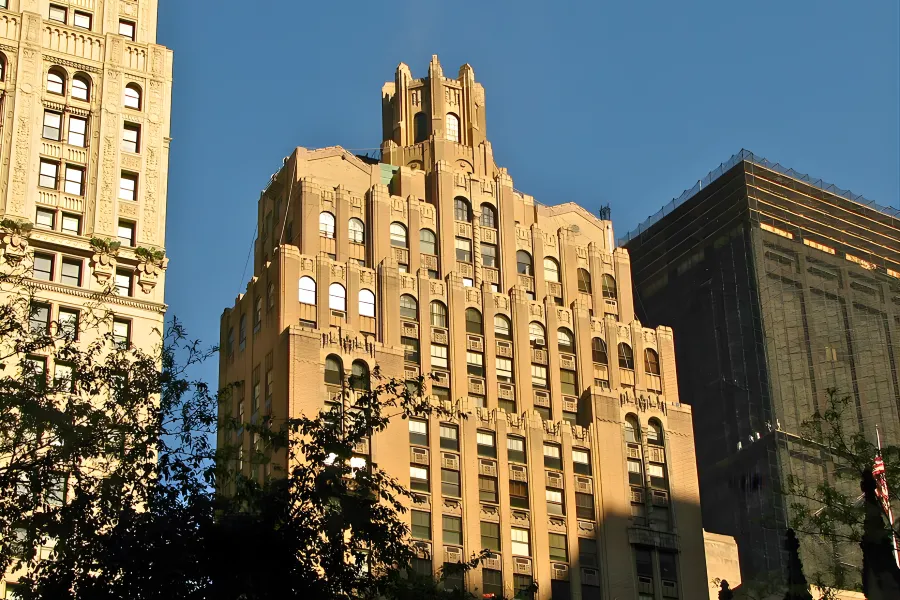
One Wall Street is the defining new development project in Financial District and one of the most architecturally significant residential conversions in Manhattan’s recent history. The building is a 566-unit conversion of the landmark Art Deco tower originally built in 1931 as the headquarters of the Irving Trust Company. It is a New York City landmark. The exterior is 50 stories of Indiana limestone with the stepped setbacks that characterize the finest Art Deco commercial architecture of its era, and those setbacks give 47 apartments private terraces that simply do not exist in purpose-built residential towers.
The famous Red Room, the original banking hall with its floor-to-ceiling mosaic tile work that was among the most celebrated interior design achievements of the 1930s, has been preserved as part of the building’s retail and amenity program. Walking through it as a resident rather than as a visitor is one of those specifically New York experiences that no new construction building can replicate.
Residences range from studios to four-bedroom homes. Interiors combine contemporary downtown finishes with the proportions and ceiling heights that only a building of this era and ambition could produce. The amenity package is anchored by The One Club, 100,000 square feet of resident-only programming including a 75-foot pool on the 38th floor with harbor views, a full-service fitness facility, private dining, a playroom, and a canine club. Ground-floor retail includes Whole Foods, which has become a genuine neighborhood anchor for the growing FiDi residential population, and Printemps, the French luxury department store’s first United States location.
One Wall Street has been actively selling sponsor units throughout 2025 and into 2026, with momentum accelerating after the building adjusted its pricing strategy. A 33rd-floor unit sold for over $9 million in August 2025, the neighborhood’s most expensive residential sale in nearly three years at that point. The building has picked up significant sales velocity since then. Pricing ranges from approximately $700,000 for studios to well above $10 million for larger units and residences on upper floors. Sponsor inventory remains available across multiple unit types and floors, which means buyers still have genuine selection rather than being limited to what is left after the most desirable units have already closed.
125 Greenwich Street
125 Greenwich Street is an 88-story, 912-foot tower designed by the late Rafael Vinoly, one of the most significant architectural achievements in lower Manhattan’s residential history. The building’s distinctive curved corners, exposed concrete I-beam columns, and column-free floor plates are immediately recognizable on the downtown skyline and produce residences with genuinely dramatic proportions. The altitude matters here in a way that is specific to this building. Views from upper floors encompass the entire harbor, the Statue of Liberty, Brooklyn, and the Manhattan skyline to the north in a panoramic sweep that most Manhattan buildings at any price point cannot match.
The building offers studio to three-bedroom homes with interiors designed by MAWD across three distinct palettes inspired by the building’s views. Each palette reflects a different relationship to the light and landscape the building commands. The top three floors, known as The 88, are dedicated entirely to resident amenities including a lap pool, spa, fitness center, and an exclusive private club with panoramic city views that serve as a genuine gathering space for the building’s residents rather than amenities that exist primarily for marketing purposes.
As of December 2025 the building had surpassed $150 million in total sales and was actively closing on residences. The project has had a long development history and the pricing has been adjusted significantly from the original aspirational levels, with the average price per square foot now sitting around $2,000. That represents meaningful value relative to comparable tower product in Midtown or along the 57th Street corridor. Studios start around $800,000 and larger units with harbor views range into several million dollars. The building’s sales pace has accelerated in recent months and the remaining inventory is moving.
77 Greenwich Street
77 Greenwich Street is an 89-unit new construction tower that represents a different scale of new development ownership than One Wall Street or 125 Greenwich. With 89 units in a purpose-built residential tower, the building offers the community character of a boutique address while delivering the contemporary design and amenity standards that new development buyers expect. Residences offer views of the Hudson River, the harbor, and the New York skyline. The building combines residential condominiums with a ground-floor Public School 150, which has made the building particularly relevant to buyers who value having a quality school within the building’s own footprint.
77 Greenwich has been one of FiDi’s consistently active selling projects through 2025 and into 2026, with strategic price adjustments made to maintain absorption through a period when the broader FiDi new development market was carrying more inventory than it could absorb at original pricing levels. Those adjustments have worked. For buyers who want a newer building at a human scale, without the management complexity and sheer size of a 566-unit or 272-unit project, 77 Greenwich delivers a specific and compelling ownership experience with remaining sponsor inventory still available.
130 William Street
130 William Street is a new construction tower that has become one of FiDi’s most architecturally celebrated residential buildings. The building’s distinctive arched windows and sculptural concrete facade have made it one of the most recognizable new residential addresses in lower Manhattan and given it an architectural identity that sets it apart from the converted commercial towers that define most of FiDi’s new development landscape.
Sponsor units remain available and the building has seen strong transaction activity throughout 2025, including penthouse sales above $7 million that have set neighborhood pricing benchmarks. For buyers who specifically value architectural distinction and design pedigree alongside the new development ownership experience, 130 William delivers that most fully among FiDi’s current active projects. The building’s amenities include a pool, fitness center, residents’ lounge, and outdoor terraces that make use of the building’s dramatic form.
101 Wall Street
101 Wall Street is a more recent conversion that sits at the intersection of the Seaport district and the Wall Street corridor, giving it a specific positioning that differs from the towers further west. The building’s prewar character, generous ceiling heights, herringbone floors, and oversized casement windows deliver a warmth and residential intimacy that buyers who want prewar charm alongside the ownership flexibility of a new condo conversion consistently respond to. The building’s location puts residents within easy walking distance of the Tin Building, the Seaport’s dining and cultural programming, and the NYC Ferry at Pier 11 while remaining in the Financial District’s extraordinary transit network.
Sponsor units are actively available at competitive pricing relative to the neighborhood’s larger projects, and the building’s scale and character make it a specific fit for buyers who find the larger towers too impersonal or whose aesthetic preferences run toward the warm and historical rather than the contemporary and dramatic.
How the Purchase Process Works in FiDi New Development
Buying a new development sponsor unit in Financial District follows the same offering plan framework that governs all Manhattan new development, but there are neighborhood-specific dynamics that informed buyers should understand before going into contract. The conversion character of most FiDi new development creates specific considerations that do not apply to ground-up construction in other neighborhoods.
Offering plan review is non-negotiable. Every FiDi conversion involves an offering plan filed with the New York State Attorney General. These documents govern everything about your purchase, from the deposit structure to the sponsor’s rights to make changes to the building, to the specific conditions under which your deposit is or is not refundable, to the projected common charges and the assumptions underlying those projections. In conversion buildings specifically, the offering plan addresses historic preservation requirements that may limit what sponsors can change about the building’s character, building management structures that affect how decisions are made before the sponsor relinquishes control, and the allocation of costs between the sponsor and unit owners that can be more complex than in ground-up new construction. An experienced Manhattan real estate attorney who has worked on FiDi conversion transactions specifically is not a luxury in this process. It is a requirement.
Attorney independence is essential. Your attorney must be independent of the developer. This point cannot be overstated. Developer-referred attorneys have a structural conflict of interest. The offering plan review is too consequential to the terms of your purchase to compromise on the independence of the person reviewing it on your behalf.
The deposit structure requires planning. New development purchases in Manhattan typically require deposits totaling 20 percent or more of the purchase price before closing, compared to the standard 10 percent deposit in a resale condo transaction. The initial deposit at contract signing is typically 10 percent. Additional deposits may be required when the offering plan is declared effective, which happens when at least 15 percent of the building’s units are in contract, and at specified construction or closing milestones. In buildings like One Wall Street and 125 Greenwich that are already delivering closings, the timeline risk is lower than in preconstruction purchases, but understanding the complete payment schedule before signing is essential regardless of where a building is in its sales cycle.
Financing requires specific preparation. Lenders cannot fund your mortgage until the building receives a Certificate of Occupancy or Temporary Certificate of Occupancy. For buildings already delivering closings, this milestone has been reached. For any building where closings have not yet begun, confirm the CO status and the projected timeline before making any financial plans that depend on a specific closing date. Working with lenders who have experience with Manhattan new development transactions and are familiar with the specific buildings in FiDi will produce better outcomes than working with national lenders who are unfamiliar with the New York City new development underwriting environment.
Tax abatement status can make or break the math. Tax abatement status varies by building in FiDi and is one of the most critical factors in the total monthly carrying cost comparison between specific properties. Some buildings carry active 421-a abatements that materially reduce property tax obligations, sometimes by 60 to 90 percent, for a defined period that can run 10 to 25 years depending on when the building qualified. The 421-a program expired in 2022, so buildings that did not qualify before that date will not benefit from the program. For buildings with active abatements, always confirm the specific remaining term and the phase-out schedule, and model your carrying costs both during the abatement period and after expiration. The monthly difference between an active abatement and full property tax exposure can be several thousand dollars on a higher-value unit, and that difference should be in your financial model before you go into contract, not after you close.
What the Numbers Look Like in 2026
FiDi median condo price as of January 2026 is approximately $1.2 to $1.3 million, up 19 to 28 percent year over year depending on the data source and measurement methodology. The median asking price across the neighborhood sits at roughly $1.199 million, representing an 11 percent discount to the Manhattan borough median of approximately $1.35 million. On a per-square-foot basis, FiDi new development trades at approximately $1,500 to $2,500 depending on building, floor, and exposure.
The value comparison against Tribeca is the one that makes financially sophisticated buyers stop and pay attention. Tribeca median pricing for comparable product runs in the mid-$3 million range, with per-square-foot pricing of $2,500 to $4,000 and above for the loft and new construction product that defines the neighborhood’s premium tier. FiDi’s discount to Tribeca is real, it is meaningful, and it reflects historical perception of the neighborhood as a commercial district rather than a residential one. That perception is closing. The 46.7 percent surge in FiDi buyer searches for 2026 is the clearest market signal that buyers are catching up to what the buildings have always been able to deliver. Days on market across FiDi dropped from 103 days to 85 days year over year, which is one of the most significant velocity improvements of any Manhattan neighborhood in the current cycle.
For buyers doing the per-square-foot math, the question is not whether FiDi offers value relative to Tribeca. It clearly does. The question is whether the neighborhood’s continued evolution toward the kind of fully realized residential identity that Tribeca has achieved will be reflected in pricing over your expected hold period. The data on buyer search volume, transaction velocity, and neighborhood infrastructure investment points in one direction.
Pricing Strategy and Negotiation
Several of the active FiDi new development projects have adjusted pricing from their original aspirational levels to current market rates, which creates a specific opportunity for informed buyers that did not exist in the earlier phases of these buildings’ sales cycles.
The most effective negotiation in FiDi new development, as across all Manhattan new development, focuses on off-deed concessions rather than recorded price reductions. Recorded price reductions are public information and affect every comparable unit in the building. A sponsor who reduces the recorded price on one unit has effectively reduced the pricing benchmark for every other unit in the same line or on similar floors. Sponsors are deeply reluctant to do this. What they will do, in the right circumstances with the right buyer, is offer concessions that do not appear in the public record.
Sponsor-paid transfer taxes are the most valuable concession available in FiDi new development conversations. In a standard new development transaction, the buyer pays the seller’s transfer taxes, which combined between New York State and New York City run 1.825 to 2.075 percent of the purchase price. On a $2 million purchase that represents over $36,000. On a $3 million purchase it is over $54,000. A sponsor who agrees to cover the transfer taxes as a closing cost concession is providing a benefit of that scale without it affecting any public record. This concession is most available to buyers who are willing to pay close to or at the asking price, since the sponsor’s willingness to absorb the transfer tax is directly connected to their satisfaction with the overall deal economics.
Working capital contribution waivers, storage unit inclusions, parking, finish upgrades within pre-construction allowances, and resident manager unit contribution reductions are additional concession categories worth exploring before you sign your contract. The moment to negotiate is before the contract is signed, not after. Once you are in contract your leverage decreases substantially with every step toward closing.
Understanding where each building sits in its sales cycle before entering negotiations gives you a materially better outcome. A building that is 30 percent sold and actively marketing has a different incentive structure than one that is 75 percent sold and closing out final inventory. The closer a project is to sellout, the less flexibility exists and the more the remaining inventory tends to be the product the market found least compelling at original pricing levels.
What to Look for When Evaluating Each Building

Reserve Fund Health
The reserve fund tells you whether the building’s financial position is strong enough to handle capital needs without imposing special assessments on unit owners. In a new development or recently converted building, the reserve fund should have been established through the working capital contributions collected at closing. Request the most recent audited financial statements and have your attorney review them. A reserve fund that is thin relative to the building’s age, size, and anticipated capital needs represents a risk of future special assessments that buyers should factor into their total cost of ownership analysis.
Common Charge History and Projections
Common charges in new development buildings are projected in the offering plan based on assumptions about staffing, utilities, insurance, and maintenance that may not reflect actual operating experience. First-year common charges in new development buildings frequently exceed the offering plan projections, sometimes materially. For buildings that have been operating for a year or more, compare the current actual common charges to the offering plan projection. The gap tells you how accurate the sponsor’s underwriting was and gives you a more reliable basis for modeling your ongoing carrying costs.
Floor Plan Efficiency and Livability
Converted commercial buildings sometimes produce unit configurations that reflect original floor plates rather than residential design logic. A floor plan that looked workable as a diagram can feel awkward, cramped in unexpected places, or poorly lit when you are actually standing in it. Study how each specific apartment lives in person, not just on the floor plan. Pay attention to the relationship between rooms, the quality and quantity of natural light at different times of day, ceiling heights throughout rather than just in the main living area, and the practicality of the kitchen and bathroom configurations. These are the elements of daily life that you cannot change after closing.
Building Management Quality
Management quality in a new development building reveals itself in the physical condition of every part of the building, not just the lobby, amenity spaces, and sales gallery. The condition of service areas, freight elevators, laundry rooms, back-of-house corridors, and mechanical spaces tells you how the management team operates when no one is being impressed. Buildings where only the client-facing spaces receive attention are signaling something about their management standards that a buyer should factor into their decision. Visit the building at different times of day and look beyond the parts that were designed for your visit.
The Sponsor’s Track Record
In a market where multiple projects have adjusted pricing, extended timelines, and navigated significant challenges between conception and delivery, the sponsor’s track record of delivering on commitments matters as much as the building’s design and amenities. Research the developers behind any project you are seriously considering. Look at their completed buildings. Talk to residents if you can. Understanding who you are buying from, and what their history of standing behind their product looks like, is part of the due diligence that separates informed buyers from those who discover important information after closing.
Seller Perspective
If you own a sponsor unit or resale condo in one of these FiDi buildings and are considering selling, 2026 is among the strongest seller environments this neighborhood has produced. The StreetEasy number one ranking, the improvement in days on market from 103 to 85, the 28 percent year-over-year median price appreciation, and the active buyer pool that the search volume surge reflects all support confident, accurately priced listings moving efficiently.
The most important variable for FiDi sellers is building-specific pricing precision. Buyers in this market are doing granular analysis of comparable sales within specific buildings, not across the neighborhood broadly. A well-priced unit in One Wall Street is competing against other One Wall Street units with similar characteristics. Price against your building’s recent closed transactions rather than against the neighborhood’s overall trend or against other buildings whose product is fundamentally different from yours.
Present your apartment professionally. In a market where buyers have genuine options across multiple active new development projects and resale inventory, the presentation of your specific unit matters. Staging, professional photography, and move-in ready condition consistently produce better outcomes than listings that ask buyers to imagine past the current state of the apartment.
Time your listing for the spring window from February through May when buyer activity is historically strongest in Manhattan. Sellers who enter this window with accurate pricing and professional presentation consistently achieve the strongest outcomes the current market supports.
Financial District new development is one of the most compelling opportunities in Manhattan real estate right now. The buildings are genuinely extraordinary. The pricing represents real value relative to comparable downtown product. And the neighborhood’s continued evolution, supported by office-to-residential conversions that are adding residential population density, growing retail and dining infrastructure, and the sustained buyer interest that the search data is reflecting, points toward continued appreciation over any reasonable hold horizon. If you are evaluating a specific building, working through an offering plan, or trying to understand how FiDi new development fits your overall purchasing strategy, reach out directly. I specialize in downtown Manhattan and have direct familiarity with the specific buildings and dynamics that determine outcomes here.
Frequently Asked Questions
The active new development and sponsor unit buildings in Financial District in 2026 include One Wall Street, the 566-unit Art Deco landmark conversion with studio to four-bedroom active sponsor units available; 125 Greenwich Street, the 272-unit Rafael Vinoly-designed tower actively closing on residences; 77 Greenwich Street, an 89-unit new construction tower selling toward sellout; 130 William Street, a new construction building with sponsor units and strong recent transaction momentum; and 101 Wall Street, a prewar conversion with active sponsor inventory at competitive pricing relative to the larger projects.
FiDi new development pricing ranges from approximately $700,000 for studios to well above $10 million for larger units and penthouse product in the most prestigious buildings. The median condo price in FiDi was approximately $1.2 million in early 2026, up 19 percent year over year. On a per-square-foot basis, FiDi new development runs $1,500 to $2,500 depending on building, floor, and exposure, representing a meaningful discount to comparable Tribeca product at $2,500 to $4,000 per square foot.
The data makes a strong case. FiDi ranked number one on StreetEasy’s most searched neighborhoods for 2026 with a 46.7 percent jump in buyer searches. Median condo prices are up 19 to 28 percent year over year. Days on market dropped from 103 to 85. The pricing discount to Tribeca remains significant on a per-square-foot basis. The neighborhood’s residential infrastructure has crossed a meaningful threshold with the arrival of Whole Foods, Eataly, the Tin Building, and Printemps. And the active new development buildings have genuinely exceptional product at price points that still reflect the neighborhood’s evolving rather than arrived residential identity.
The most important factors are the building’s reserve fund health, the gap between offering plan common charge projections and current actual charges, tax abatement status and remaining term, the specific floor plan’s livability in person beyond what renderings and floor plans show, the sponsor’s track record with completed projects, and where the building sits in its sales cycle which directly affects your negotiating leverage. Independent attorney review of the complete offering plan is essential and your attorney must be independent of the developer.
Yes, and the FiDi market in 2026 offers more negotiating opportunity than many buyers realize. Several active projects have adjusted pricing from original aspirational levels, and sponsor-paid closing cost concessions, particularly transfer tax coverage running 1.825 to 2.075 percent of the purchase price, are available in the right conversations with the right buildings. On a $2 million purchase that represents over $36,000 in savings. On a $3 million purchase it exceeds $54,000. Focus negotiation on off-deed concessions rather than recorded price reductions, and negotiate at contract signing rather than after.
New development in FiDi means purchasing from the sponsor directly, governed by an offering plan rather than a standard sales contract. The deposit structure typically requires 20 percent or more before closing compared to 10 percent for resale. Closing costs are higher because sponsor transfer taxes are passed to the buyer. The timeline depends on CO status rather than a predictable 60 to 90 day closing window. The negotiating dynamics focus on off-deed concessions rather than the transparent market-driven price negotiation of a resale transaction. The upside is no board approval, full financing flexibility, strong sublet rights, and in the best FiDi buildings, a genuinely extraordinary residential product that resale cannot replicate.
These are FiDi’s two most significant active new development projects and they deliver genuinely different experiences. One Wall Street is a prewar Art Deco landmark conversion with 566 units, a limestone exterior, preserved historic interior spaces including the famous Red Room, and a 100,000 square foot amenity program anchored by a 38th-floor harbor view pool. It is quintessentially New York in character, history, and presence. 125 Greenwich is a contemporary 88-story glass tower with curved corners, column-free floor plates, dramatic altitude, and unobstructed harbor views from upper floors, with a top-three-floor amenity suite. It is a statement of contemporary design and the specific experience of living at genuine altitude over lower Manhattan. The right choice depends entirely on whether your priorities run toward architectural heritage and neighborhood presence or toward contemporary tower living and views.
Closing costs for new development purchases in FiDi typically run 5 to 6 percent of the purchase price or more for financed buyers. The primary driver above standard resale closing costs is the transfer tax pass-through from the sponsor, which combined runs 1.825 to 2.075 percent of the purchase price. Additional new development closing costs include the working capital contribution of approximately two months of common charges, the sponsor’s attorney fee, title insurance, the mortgage recording tax of 1.8 to 1.925 percent of the loan amount for financed buyers, the mansion tax on purchases above $1 million, and your own attorney fees. Budget these costs specifically before evaluating a purchase price, not as an afterthought at the end of the process.